The customs tariff number for your goods, explained simply
At a glance
A commodity code, also called a customs tariff number or tariff code, is the number you use to declare goods to customs. It decides which duty rate applies, which taxes are due and which rules your product has to meet. In the EU, the commodity code has ten digits for imports and eight digits for exports. It is built from the international HS code, the EU's Combined Nomenclature and TARIC. Getting it wrong can mean back payments, delays at the border and penalties.
Would you rather not deal with this yourself? We find the correct commodity codes for your products.
Contact usWhat is a commodity code?
A commodity code is the number that classifies your product in the customs tariff. It tells customs exactly what you are importing or exporting. On that basis, customs calculates the duties and checks whether any restrictions, licences or bans apply.
In everyday use, the term is often treated as a synonym for HS code. Strictly speaking, the HS code is only the first six digits: the commodity code is the full EU number that adds further digits on top.
Not sure which code fits your product? We will classify it for you →
How is the customs tariff number structured?
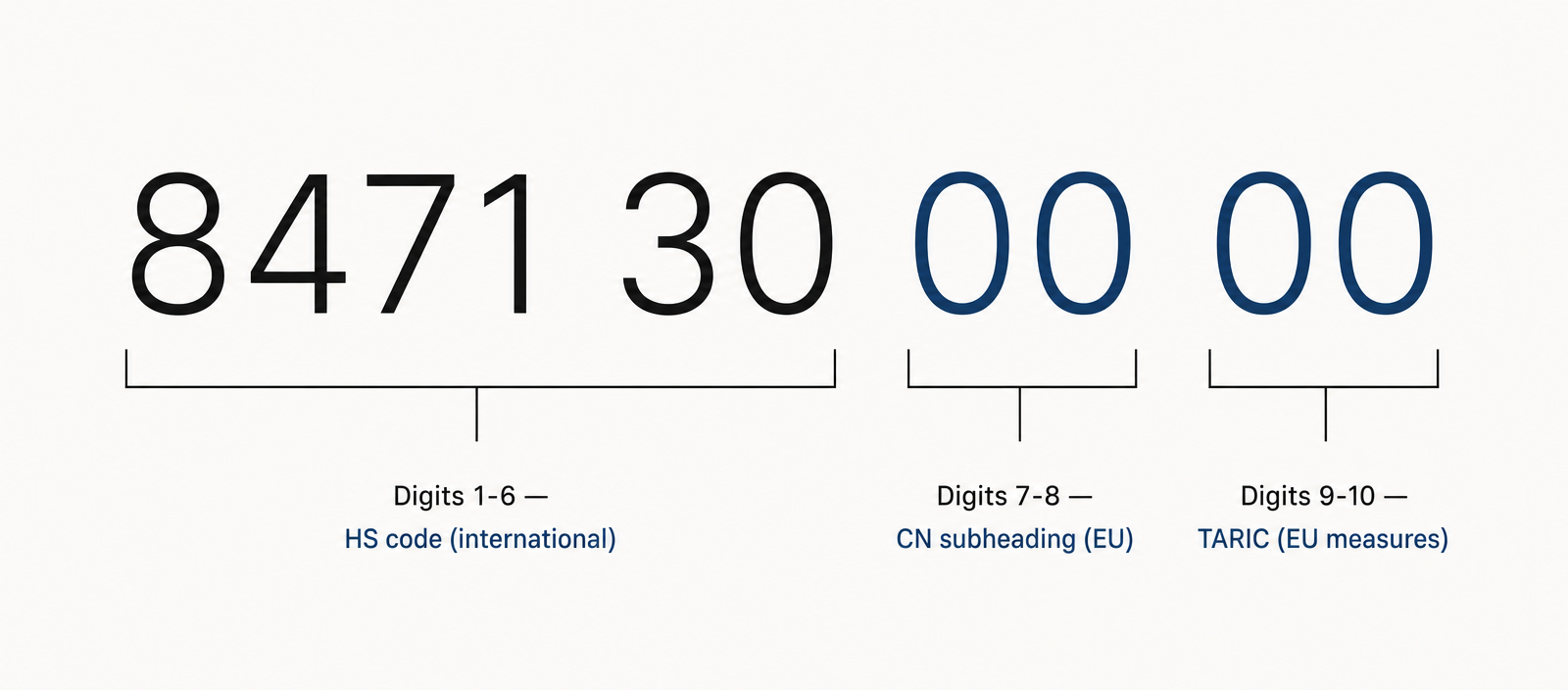
The commodity code is hierarchical. Every pair of digits makes the classification more precise. The first six digits are the HS code, which is identical worldwide. Digits seven and eight come from the EU's Combined Nomenclature (CN). Digits nine and ten come from TARIC, the EU database that holds duty rates and trade measures.
For an export declaration from the EU you normally use the 8-digit CN code. For an import declaration you use the full 10-digit TARIC code. Some member states add one or two national digits on top, for example Germany with an eleventh digit for statistical purposes.
When do I need a commodity code?
You need a commodity code for every customs declaration, so for every import of goods from a non-EU country into the EU and for every export to a non-EU country. Declarations are filed electronically, and no declaration can be submitted without a valid code.
Your invoices and shipping documents should also carry the commodity code so that freight forwarders, customs brokers and authorities can identify the consignment without guesswork.
Where do I find the right commodity code?
The official reference for the EU is the TARIC database of the European Commission. You can search it free of charge by product description and see the applicable duty rates and measures directly. National portals such as EZT-online in Germany or the UK Trade Tariff show the same base structure with national additions.
Classification follows the legal wording of the tariff and fixed interpretation rules, not just the product name. Material, function and degree of processing all matter. For legally binding certainty you can apply for a Binding Tariff Information (BTI) decision, or have the classification done by us.
What happens if the commodity code is wrong?
An incorrect code can mean that customs reclaims underpaid duties retroactively, in the EU generally for up to three years. It can equally mean that you pay far more duty than necessary, that your shipment is held at the border or that a penalty procedure is opened.
The declarant remains legally responsible, even when a forwarder or customs broker handles the formalities. It pays to check the classification before your first shipment rather than after a customs audit.
We find your commodity code
Tell us briefly what you trade and we will determine the correct commodity codes for your products. Just adjust the message below and send it to us.
Frequently asked questions
Is a commodity code the same as an HS code?
- Not quite. The HS code is the 6-digit international basis. The EU commodity code has eight digits for exports and ten digits for imports, and contains the HS code as its first part. In everyday use the terms are often used interchangeably.
Is a commodity code the same as a customs tariff number?
- Yes. Commodity code, customs tariff number and tariff code all describe the same thing: the number that classifies your goods in the customs tariff. Different countries and carriers simply prefer different wording.
Where do I find the commodity code for my product?
- Free of charge in the European Commission's TARIC database, or in a national tariff portal such as EZT-online in Germany. Searching takes some practice because classification follows fixed legal rules. If you are unsure, we determine the code for you.
How many digits does a commodity code have?
- Six digits worldwide as the HS code, eight digits for EU export declarations and ten digits for EU import declarations. Some member states add national digits, for example the 11-digit German customs tariff number.
What does a Binding Tariff Information (BTI) cost?
- A BTI decision from an EU customs authority is free of charge, but it binds you to the result and usually takes several weeks. If you need an answer faster, we can carry out the classification for you.
Sources & further reading
- European Commission: TARIC database
- European Commission: Combined Nomenclature (CN)
- World Customs Organization: Harmonized System
This page is general guidance and not legal advice. Binding decisions on classification are always made by customs.