The global product classification for customs, explained in plain language
At a glance
An HS code (Harmonized System code) is an internationally standardised number that classifies traded goods. Customs authorities around the world use it to determine which duties, taxes, and rules apply to a product. If you import goods into the EU or export them out of it, you must state the correct code in your customs declaration. A wrong code can mean wrong duties, delays, or fines.
Don't feel like dealing with this topic? We'll take care of it for you.
Contact usWhat is the HS code used for?
The HS code tells customs what your product is. Based on that classification, customs determines the import duty rate, whether import VAT applies, and whether the product is subject to restrictions, for example licences, quotas, or bans.
More than 200 countries and economies use the Harmonized System, which is maintained by the World Customs Organization (WCO). It covers roughly 98% of world trade, which is why the first six digits of a product's classification are identical almost everywhere.
Not sure which code fits your product? We classify it for you →
How is an HS code structured?
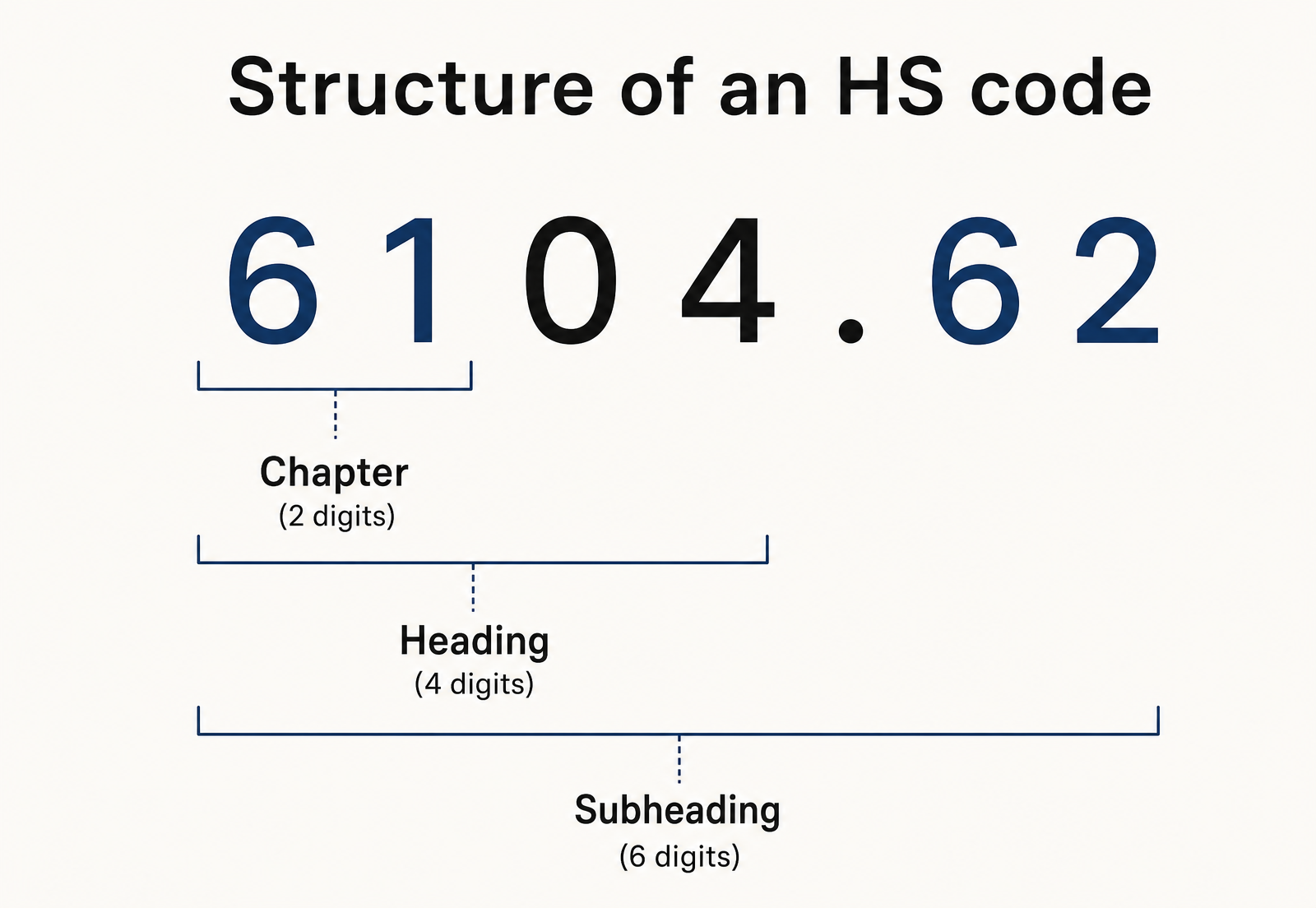
The HS code is hierarchical and six digits long. The first two digits identify the chapter (the broad product group), the first four digits the heading, and all six digits the subheading. Each additional digit makes the classification more specific.
Individual countries and customs unions extend the code beyond six digits. The EU adds two digits for its Combined Nomenclature (8 digits) and two more for TARIC (10 digits). The USA uses 10-digit HTS codes. The first six digits always stay the same.
HS code, CN code, TARIC code: what is the difference?
These terms describe the same system at different levels of detail. The HS code (6 digits) is the international base. The CN code (8 digits) is the EU's Combined Nomenclature, which refines the HS code. The TARIC code (10 digits) is what you actually declare when importing into the EU. It encodes the exact duty rate and any trade measures.
For practical purposes: when someone in the EU asks you for a 'customs tariff number' or 'commodity code', they usually mean the 8- or 10-digit version, but the first six digits are always the HS code.
How do I find the right HS code for my product?
Classification follows the General Rules of Interpretation and the wording of the headings, not just the product name. Material, function, and degree of processing all matter. The same type of product can fall under different codes depending on these factors.
You can search the EU's official TARIC database or Germany's EZT-online portal for free. For legally binding certainty, you can request Binding Tariff Information (BTI) from customs or let us classify the product for you.
What happens if the HS code is wrong?
An incorrect code can lead to underpaid duties that customs later collects retroactively, sometimes for several years. It can also mean overpaying duties unnecessarily, shipments being held at the border, or administrative fines.
Because the declarant is responsible for the classification, it is worth getting the code right before the first shipment, not after a customs audit.
Let us find your HS code
Tell us what you trade and we will determine the correct HS code for your products. Just adjust the message below and send it to us.
Frequently asked questions
Is the HS code the same in every country?
- The first six digits are standardised worldwide. Beyond that, each country or customs union adds its own digits: 10 in the EU (TARIC), 10 in the USA (HTS). So always state the full national code in your declaration.
Where can I look up an HS code for free?
- The EU's official TARIC database and Germany's EZT-online portal are free to use. Your national customs authority usually offers a similar search tool.
Do I need an HS code for every shipment?
- Yes, every customs declaration requires a classification code for each product. Without it, the shipment cannot be cleared.
Who is responsible for the correct HS code?
- The declarant named in the customs declaration is legally responsible for the classification, even if a broker or freight forwarder fills in the paperwork. If you are unsure, we can classify your products for you.
Sources & further reading
This page is general guidance, not legal advice. Classification decisions are always made by customs authorities.