The EU's 10-digit customs code, explained in plain language
At a glance
The TARIC code is the 10-digit classification number of the European Union's integrated tariff. It builds on the international HS code and tells EU customs exactly which duty rate, taxes, and trade measures apply to your product. When you import goods into the EU, the full 10-digit TARIC code is what you state in the customs declaration. An incorrect code can mean wrong duties, held shipments, or fines.
Don't feel like dealing with this topic? We'll take care of it for you.
Contact usWhat is the TARIC code used for?
TARIC (Tarif Intégré de la Communauté) is the EU's integrated customs tariff database, often called simply the TARIC database. The 10-digit TARIC code, sometimes referred to as the TARIC number, encodes everything customs needs to know about a product: the duty rate, anti-dumping measures, tariff quotas, import licences, and other trade policy measures.
While the international HS code only classifies the product itself, the TARIC code also determines which EU measures apply. That is why importers cannot rely on the 6-digit HS code alone.
Not sure which TARIC code fits your product? We classify it for you →
How is a TARIC code structured?
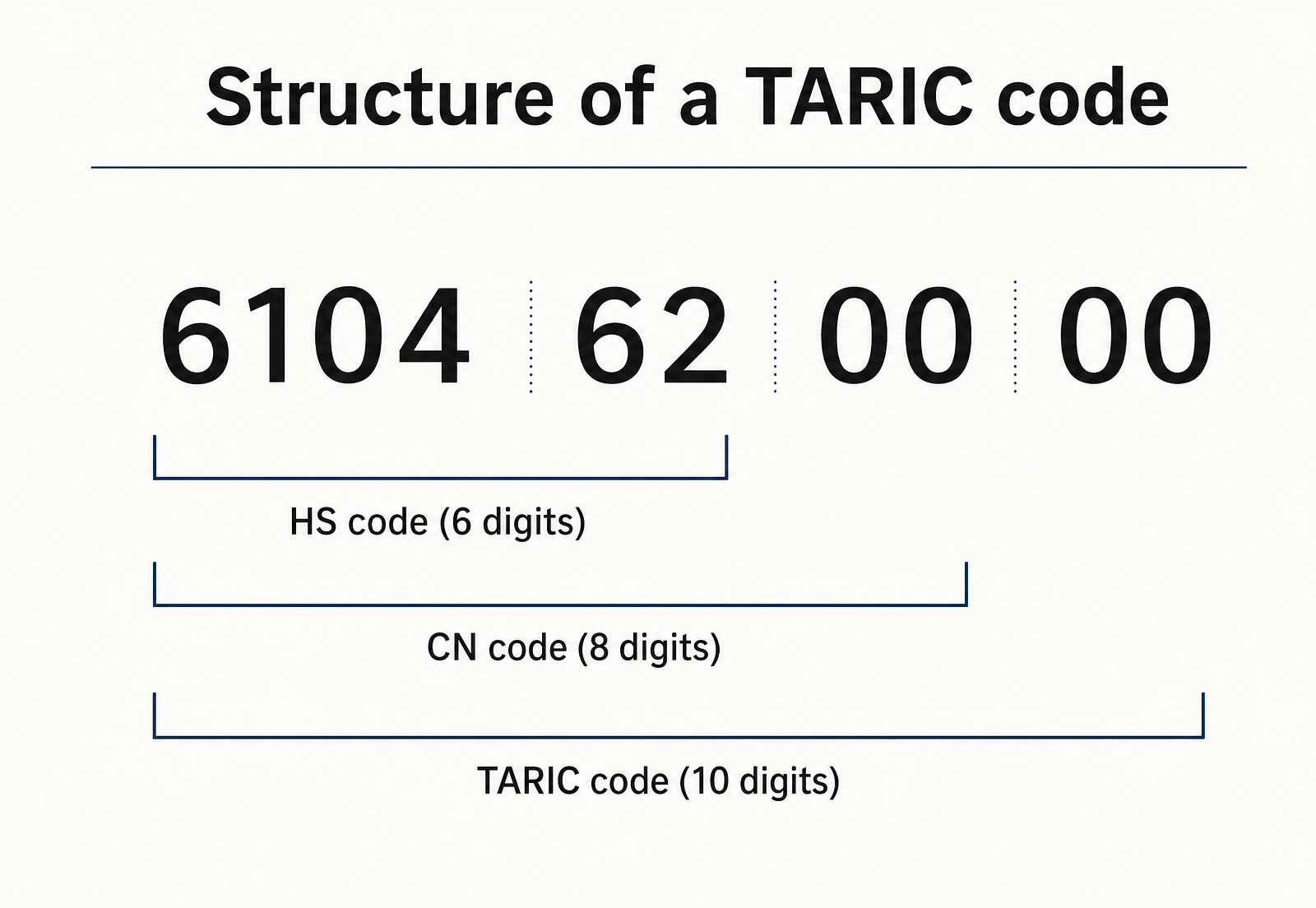
The TARIC code is built in layers. The first six digits are the international HS code, identical worldwide. Digits seven and eight come from the EU's Combined Nomenclature (CN), which refines the classification. Digits nine and ten are TARIC's own subheadings, which capture EU-specific measures such as anti-dumping duties.
In practice this means: the 10-digit TARIC code contains the 8-digit CN code, which in turn contains the 6-digit HS code. Each level adds precision.
TARIC code, HS code, CN code: what is the difference?
The HS code (6 digits) is the global base classification maintained by the World Customs Organization. The CN code (8 digits) is the EU's refinement of it, updated every year. The TARIC code (10 digits) adds the EU's trade measures and is the level at which duty rates are actually set.
For imports into the EU, only the full 10-digit code is complete. If a supplier outside the EU gives you a 6-digit code, that is a starting point, but you must determine the EU-specific digits yourself.
Where can I look up the TARIC code?
The European Commission operates the official TARIC database, which is free to use. You can search by product description or browse the nomenclature. Germany's customs administration offers the same content in EZT-online.
Searching the database gives you the likely code and the applicable duty rate, but the result is not legally binding. For binding certainty, you can apply for Binding Tariff Information (BTI), or have a specialist classify the product for you.
Why is the correct TARIC code so important?
The TARIC code directly determines how much duty you pay. A wrong code can mean paying too much or too little, which customs will collect retroactively, often for up to three years. It can also trigger missing import licences, held shipments, or fines.
Because the declarant is responsible for the classification, it pays to determine the code before the first shipment rather than during a customs audit.
Let us find your TARIC code
Tell us what you import into the EU and we will determine the correct 10-digit TARIC code for your products. Just adjust the message below and send it to us.
Frequently asked questions
Is the TARIC code the same as the HS code?
- No. The HS code is the 6-digit international base. The TARIC code extends it to 10 digits with EU-specific subdivisions and measures. The first six digits are always identical.
Do I need the TARIC code for exports too?
- For exports from the EU, the 8-digit CN code is generally sufficient. The full 10-digit TARIC code is required for imports into the EU.
How often does the TARIC code change?
- The Combined Nomenclature is updated every year, and TARIC measures can change at any time, for example when new anti-dumping duties are introduced. It is worth checking the code for recurring shipments regularly.
Who is responsible for the correct TARIC code?
- The declarant named in the customs declaration is legally responsible for the classification, even if a broker or freight forwarder handles the paperwork. If you are unsure, we can classify your products for you.
Sources & further reading
This page is general guidance, not legal advice. Classification decisions are always made by customs authorities.