What a company has to do once every twelve months to keep its entry active
In short
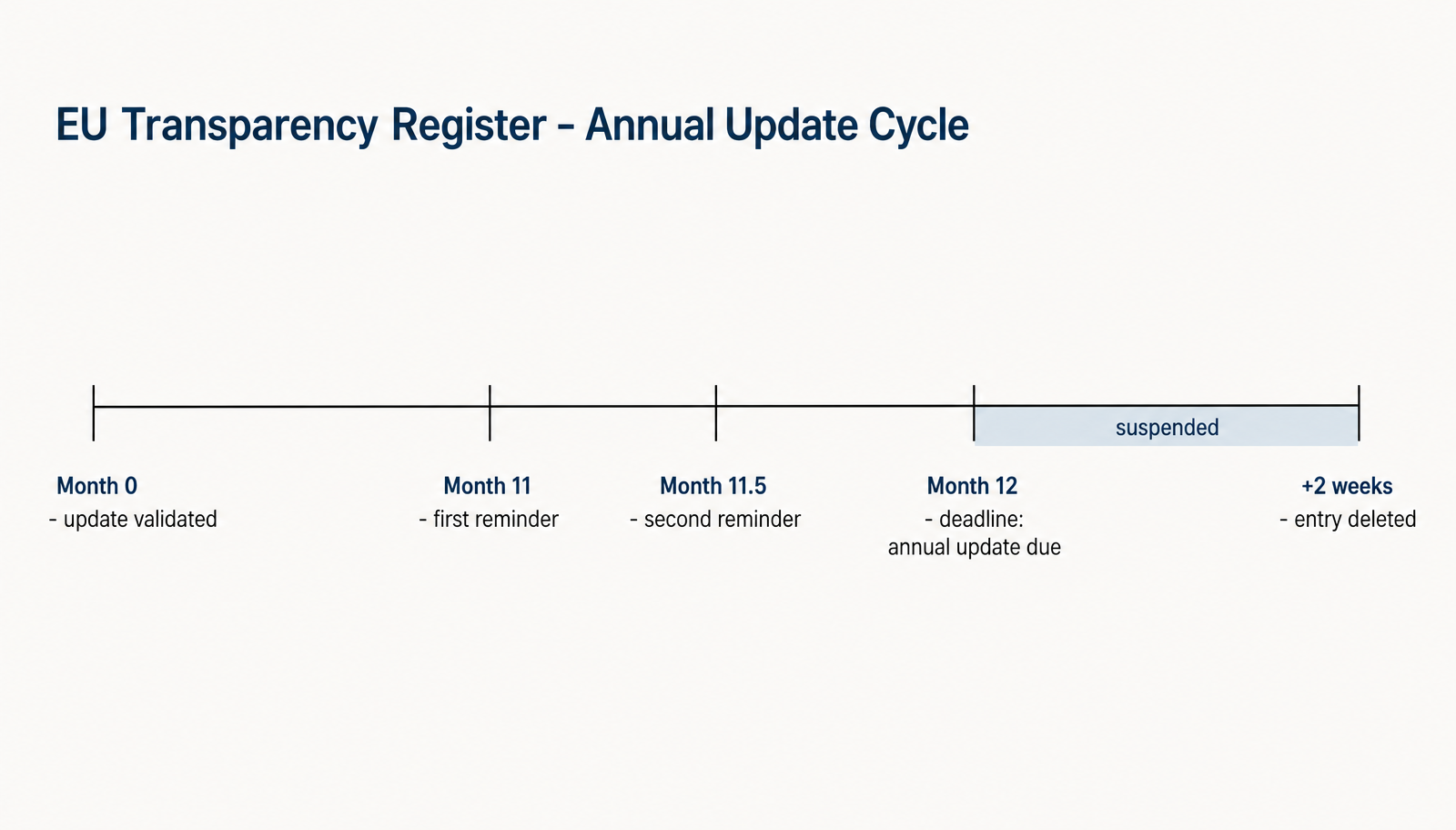
Every twelve months you must reopen your entry, review all fifteen headings, refresh your staffing and financial figures, re-confirm that you observe the code of conduct, and submit. Miss the deadline and the entry is suspended. Two weeks later it is deleted and you have to apply again from scratch.
Would you rather not deal with this yourself? We run the annual update for your entry, from the financial figures to submission.
Contact usWhat the EU Transparency Register is, and who keeps an entry
The EU Transparency Register is the public database of organisations that seek to influence the law-making and policy of the European Parliament, the Council and the European Commission. Companies, trade associations, consultancies, law firms, NGOs, think tanks and academic institutions all appear in it.
Registration is not a one-off act. An entry only stays valid if it is kept accurate, and the register enforces that through a mandatory update once every twelve months. In practice, being registered is a condition for a great deal of access: meetings with senior Commission staff, speaking slots at hearings, European Parliament access passes and membership of expert groups.
Your deadline and the three reminders
The deadline falls one year after your registration was validated, or one year after your last annual update. Running the update early resets the clock, which is a legitimate way to move an inconvenient deadline away from a busy month.
Reminders go to the contact person and to everyone on the access list. Use a functional mailbox such as info@yourcompany.com rather than an individual's address: a departed colleague is the single most common cause of a missed deadline.
Between deadlines, correct any change in your entry within three months. The guidelines recommend reviewing the entry about three times a year, which is far less work than reconstructing everything once annually.
Before you open the form
Collect the following before you log in. Most of the time lost in an annual update goes on chasing figures, not on filling in fields.
Have ready
Watch out for
EU Login account for someone on the access list
The account must match an e-mail address listed in the entry
Most recent closed financial year
Twelve consecutive months, and it need not match the calendar year
Cost, revenue or budget figures for that year
Costs of covered activities only, not turnover and not total expenditure
Headcount on covered activities, with hours
Include unpaid people and anyone holding a European Parliament access pass
EU files you worked on
Full official titles, not policy areas such as 'climate'
Intermediaries hired, or clients served
Including new ones taken on in the current financial year
EU grants received
Amount in euro, programme and funding authority
Membership lists, in and out
A link to a public web page is easier to keep current than a list
The update, step by step
The form itself is straightforward once the inputs are in place. The order below is the one that produces the fewest questions from the Secretariat.
- 01Check who can get in. Access is granted automatically to whoever filed the original form, the person with legal responsibility, the person in charge of EU relations and the contact person. Each needs an EU Login account tied to the exact address listed, and the entry requires at least two different addresses. Fix a dead access list now, not two weeks before the deadline.
- 02Open the form. Log in with EU Login on the register website and choose the annual update from the 'Search, register or update' area, or through your restricted space.
- 03Choose annual or partial. The annual update is a full review of all fifteen headings plus re-confirmation of the code of conduct, and it resets the twelve-month clock. A partial update edits selected headings mid-year without moving your deadline, and never replaces the annual one.
- 04Work through all fifteen headings. Each heading needs a conscious 'still correct' or 'needs changing'. React to any warning message the system shows next to a field instead of ignoring it, and use the information bubbles when unsure. Meetings with Commissioners, contributions to consultations and expert group memberships are fed in automatically from Commission systems, so you neither enter nor remove those.
- 05Refresh the people figure (heading 10). Count only individuals carrying out activities covered by the register, paid or not: employees, interns, volunteers, consultants, academics. Anyone holding a European Parliament access pass must be included. Three people at 40, 20 and 10 hours a week is 70 divided by 40, so 1.75 FTE. There is no minimum threshold, and you should update mid-year too if the number moves by around a quarter or more.
- 06Update the financial data (heading 14). Figures cover the most recent closed financial year. What you declare depends on the interest type you chose under heading 8, set out in the next section.
- 07Run the check, then submit. The summary page has a 'Run check' button that tests completeness, and it works at any point, not only at the end. Fix what it flags and submit. A draft that is never submitted is deleted after 21 calendar days. The contact person gets a confirmation e-mail, and if the Secretariat asks questions, the update is not finished until you answer them.
- 08Close the loop. Keep the working file behind your financial estimate, because the Secretariat may ask how you calculated it. Diarise the new deadline internally at eleven months, and circulate the code of conduct to anyone doing interest representation for you.
What to re-check, heading by heading
All fifteen headings are reviewed at every annual update. This is what actually tends to change from one year to the next.
Heading
What changes in practice
1 Name and form
Legal name, legal form, a working website address
2 Contact details
Head office and, where relevant, the EU office
3 Person with legal responsibility
Still in post and still able to act for the organisation
4 Person in charge of EU relations
Public affairs staff turnover
5 Contact person
Address still monitored, and at least one functional mailbox
6 Access list
Leavers and joiners, at least two addresses with valid EU Login
7 Goals and remit
Still accurate, maximum 1,000 characters
8 Interests represented
Own or members' interests, clients' interests, or non-commercial. This drives heading 14
9 Covered activities
New and closed EU files, campaigns, publications, intergroups, EU forums
10 People involved
Headcount and FTE for covered activities only
11 Fields of interest
Whether the notification subscriptions are still useful
12 Membership and affiliation
Federations joined or left, plus your own members and affiliates
13 Category
Still the best single fit for what you do
14 Financial data
Every year, without exception
15 Code of conduct
Tick to re-confirm, required at every annual update
The financial figures
All figures refer to the most recent financial year for which accounts have been closed. Every registrant declares EU grants contributing to operating costs, in euro, naming the programme and funding authority. Money received under public procurement contracts with the EU institutions is not declared.
What else you declare follows directly from the interest type you selected under heading 8.
- Own or members' interests. Companies, trade and business associations, trade unions. Declare an estimate of the annual cost of covered activities as a bracket: staff costs based on your FTE figure, a proportional share of office and administrative expenses, in-house operational spend on campaigns and events, representation costs, outsourced activity costs and a proportional share of membership fees paid to associations that themselves lobby. Costs are not turnover and not total expenditure. Name every intermediary you hired with its cost bracket, plus any engaged in the current year without a figure.
- Clients' interests (intermediary). Public affairs consultancies and law firms acting for clients. Name every client in full, since generic labels such as 'corporates' or 'confidential information' are not accepted, with a revenue bracket for each and the EU files targeted on their behalf. Include new clients taken on in the current financial year, and non-EU public authorities you act for under contract. EU institutions you serve under a procurement contract are not clients.
- Non-commercial interests. NGOs, charities, foundations, think tanks, academia. Declare your total budget in euro, your main sources of funding by category, and every individual contribution that both exceeds 10,000 euro and represents more than 10% of your budget, naming the contributor. Repeat contributions from the same donor in one year are added together. A newly formed entity with no closed financial year can use that status for a maximum of 24 months.
If you miss the deadline
Miss the deadline and the entry is suspended automatically. It stays visible, flagged as suspended, and you can still log in and complete the update. If you do not do so within two weeks it is removed and you have to apply again from the beginning, which means losing your registration date and any access that depends on it.
Separately, the Secretariat can investigate any entry at any time. Non-observance of the code of conduct can lead to removal plus a re-registration ban of up to two years.
Eight things that most often hold up validation
Where an update stalls, it is almost always one of these. Each is avoidable in the drafting.
- Abbreviations and acronyms instead of full names.
- Policy areas instead of named legislative files.
- Generic client descriptions rather than individual names.
- Promotional or self-congratulatory language.
- Ignoring the warning messages the system shows next to a field.
- Personal data under headings that did not ask for it.
- Financial figures from the wrong year, or costs confused with turnover.
- An access list with dead addresses or only one address on it.
We handle your annual update
Tell us briefly who you are registered as and when your deadline falls. We will take it from there. Just adjust the message below and send it to us.
Frequently asked questions
Is registration in the EU Transparency Register mandatory?
- Registration is not compulsory by law, but it is a precondition for a long list of interactions with the EU institutions: meetings with Commissioners, members of their cabinets and directors-general, speaking at Parliament hearings, holding a European Parliament access pass and sitting on Commission expert groups. In practice, anyone doing serious interest representation in Brussels is registered.
What happens if I miss the annual update deadline?
- The entry is suspended automatically on the day after the deadline. It remains publicly visible with a suspended flag, and you can still log in and complete the update. After two weeks the entry is removed and you have to register again from scratch.
Can I move my deadline?
- Yes, indirectly. Your deadline is always twelve months after the last validated update, so running the annual update early moves the next deadline forward by the same amount. A partial update does not move it.
Who counts towards the FTE figure under heading 10?
- Everyone carrying out activities covered by the register, whether paid or not: employees, interns, volunteers, consultants and academics, plus anyone holding a European Parliament access pass. Hours are converted against a full-time week, so three people at 40, 20 and 10 hours equal 1.75 FTE. Only the share of time spent on covered activities counts.
Do I declare my turnover?
- No. If you represent your own or your members' interests, you declare the estimated annual cost of your covered activities as a bracket, not turnover and not total expenditure. Intermediaries declare revenue per client instead, and non-commercial organisations declare their total budget.
What is the difference between an annual and a partial update?
- The annual update is a full review of all fifteen headings with re-confirmation of the code of conduct, and it resets the twelve-month clock. A partial update lets you correct individual headings mid-year, which you are expected to do within three months of any change, but it never replaces the annual update.
Official sources
- Transparency Register: guidelines for registration
- Transparency Register: annual or partial update
- Transparency Register: legal references and code of conduct
- Transparency Register: conditions for contacts with the EU institutions
- Transparency Register: FAQs and contact
This page summarises the official guidelines of the EU Transparency Register, consulted on 1 September 2026. The published guidelines always prevail. This is general guidance, not legal advice.